
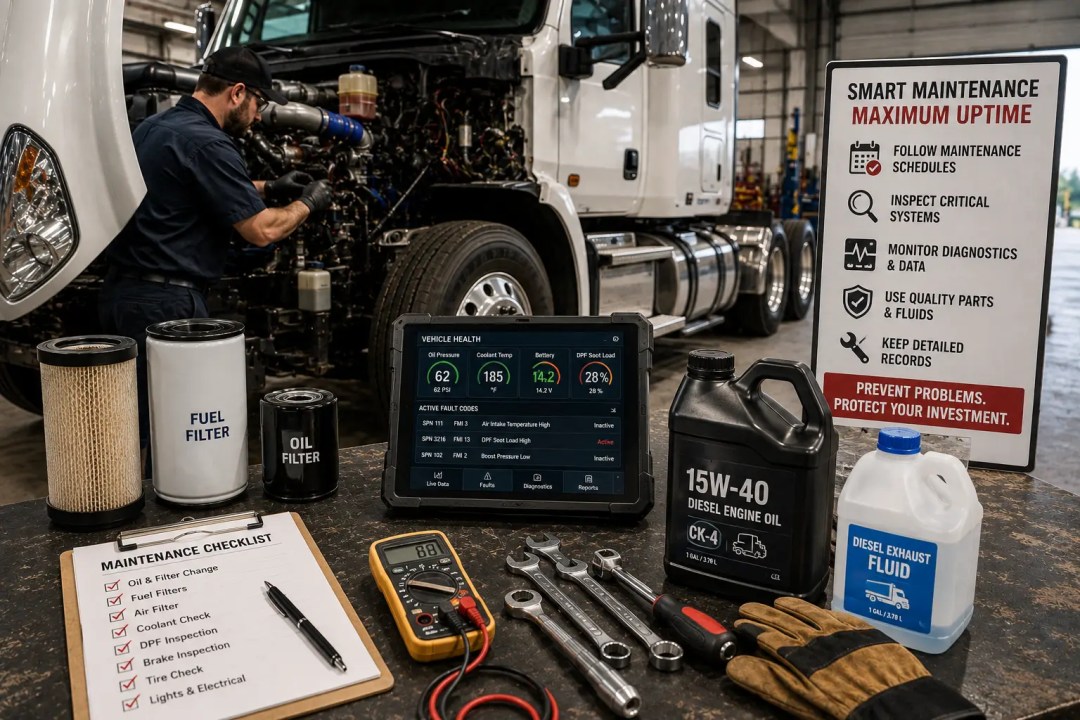
Every diesel truck owner faces this decision eventually: a part needs replacing, and the choice comes down to original equipment manufacturer (OEM) parts versus the aftermarket alternative. The aftermarket option is almost always cheaper — sometimes significantly cheaper — and that price gap can make the decision feel obvious. It rarely is.
The right choice depends on which component you’re replacing, what your truck is used for, how long you plan to keep it, and whether the part interacts with sensitive systems where a poor-quality substitute can cause damage that costs far more than you saved. Here is a practical framework for making that call correctly.
What OEM Actually Means
OEM parts are manufactured by — or to the exact specification of — the original vehicle or engine manufacturer. On a diesel truck, that means parts sourced from or meeting the standards of Cummins, Detroit Diesel, PACCAR, Duramax, or whichever engine powers your vehicle, along with the truck manufacturer for body and chassis components.
What OEM does not automatically mean is that the part was built in the manufacturer’s own factory. Many OEM components are manufactured by Tier 1 suppliers — Bosch, Delphi, Denso, Mahle — who build parts to OEM specification and supply them under the manufacturer’s brand. When you buy an OEM-branded diesel fuel filter, you may be buying the same physical product that Bosch also sells under its own label. The difference is that the OEM specification is guaranteed to match your engine’s requirements exactly.
The Case for OEM Diesel Parts
OEM parts carry three advantages that matter specifically on diesel trucks: guaranteed specification fit, emissions system compatibility, and warranty protection.
Diesel engines — particularly those built since 2007 with diesel particulate filters and since 2010 with selective catalytic reduction systems — are precision-engineered systems where component tolerances directly affect emissions compliance and engine protection. An OEM oil filter, for example, is engineered to maintain specific bypass valve pressure and filtration efficiency values that match the engine’s lubrication system design. An aftermarket filter that differs slightly in bypass pressure or media efficiency can affect oil pressure characteristics and filtration performance in ways that are invisible until engine wear accumulates.
The warranty consideration is significant for newer trucks. Using non-OEM parts in a repair can void manufacturer warranty coverage on related systems if the part’s failure or incompatibility contributes to a subsequent warranty claim — a risk that shifts more cost exposure to the owner than the upfront savings justify.
Where Aftermarket Parts Make Sense
The aftermarket is not monolithic. It ranges from premium-tier manufacturers who build to or exceed OEM specification — often at lower cost because they sell at volume without manufacturer markup — down to budget-tier suppliers whose quality control is inconsistent and whose parts may not meet OEM tolerances at all.
For non-critical, non-emissions-related components on older trucks no longer under warranty, quality aftermarket parts from reputable manufacturers are a reasonable choice. Belts, hoses, lighting components, mirrors, body hardware, standard-duty filters, and wear items like wiper blades and cabin air filters can typically be sourced from reliable aftermarket suppliers without meaningful quality compromise.
The key qualifier is a reputable manufacturer. Brands like Gates, Dayco, Wix, Donaldson, Fleetguard, and Baldwin have track records in commercial diesel that make them credible alternatives to OEM for many applications. Unbranded or unknown-origin parts sold purely on price are a different proposition entirely.
High-Risk Components: Where the OEM vs. Aftermarket Decision Matters Most
Certain diesel truck components carry disproportionate risk if the wrong part is installed. These are the systems where the price difference between OEM and aftermarket is smallest relative to the cost of failure:
- Fuel injectors: Modern common rail injectors operate at pressures exceeding 30,000 PSI with tolerances measured in microns. A remanufactured injector from a reputable specialist — Bosch, Delphi, or a credentialed independent remanufacturer — can be a legitimate alternative to new OEM. An unknown-origin aftermarket injector risks premature failure, injector balance issues, and high-pressure fuel system damage.
- Diesel Particulate Filters: Aftermarket DPF units vary widely in substrate quality, filtration efficiency, and thermal durability. A substandard DPF that fails to capture soot effectively or that cracks under thermal cycling can contaminate the SCR catalyst downstream — turning a $500 part decision into a $3,000 catalyst replacement.
- EGR valves and coolers: Exhaust gas recirculation components interact directly with engine cooling and combustion management. Low-quality aftermarket EGR coolers have documented failure modes including coolant leaks into the intake manifold — engine-damaging failures that trace back to inferior material quality.
- Turbochargers: A remanufactured turbocharger from a specialist is often the right call over a new OEM unit on cost grounds. An unbranded budget turbo with loose shaft tolerances or inadequate balancing will fail prematurely and may cause foreign object damage to the engine.
- NOx sensors and SCR components: Emissions system sensors on modern diesels require precise calibration characteristics. Aftermarket sensors that don’t match OEM output curves can cause the engine management system to misread exhaust chemistry, triggering fault codes and derates that persist even after sensor replacement.
Reading the Fault Codes First
Before buying any part to fix a diesel problem, confirm the diagnosis. A fault code pointing to a component is a starting point, not a verdict. Many parts are replaced unnecessarily because a code was taken at face value rather than verified through proper circuit testing.
Understanding what diesel fault codes are actually telling you — the difference between a failed component and a wiring fault, a sensor signal issue versus a mechanical failure — is the foundation of accurate diagnosis. A solid diesel DTC codes guide walks through the structure of diesel diagnostic trouble codes and how to interpret them correctly before committing to a parts purchase.
The Tools Required for a Proper Installation
The quality of a replacement part only translates to a quality repair if the installation is done correctly. On diesel trucks, correct installation often requires torque specifications, specific tooling, and post-installation procedures — particularly for high-pressure fuel system components, EGR systems, and aftertreatment components — that differ from what general mechanical knowledge covers.
Shops and owner-operators who do their own diesel repairs need the right diagnostic and installation equipment to verify the repair after the part is fitted. Confirming that a replacement injector is delivering the correct fuel quantity, that a new DPF is registering correctly with the engine management system, or that a turbocharger is producing expected boost pressure requires proper instrumentation. The essential diesel repair tools needed to do this work correctly are a worthwhile investment for anyone maintaining their own diesel equipment.
The Bottom Line
The OEM versus aftermarket decision on a diesel truck is not binary. It is a component-by-component assessment that weighs the criticality of the part, the quality tier of the available alternatives, the age and warranty status of the truck, and the total cost of a wrong decision — which is never just the cost of the part itself.
On emissions system components, fuel system precision parts, and anything that directly affects engine protection, OEM or premium-tier remanufactured parts from credentialed specialists are the rational choice. On non-critical wear items and commodity components, quality aftermarket parts from established manufacturers deliver good value without meaningful added risk.
Know which category each part falls into before you buy. That knowledge is worth more than the savings from getting it wrong.
About the Author:- Michael Nielsen is the editor and publisher of Heavy Duty Journal, a free digital trade publication serving diesel technicians, fleet managers, and owner-operators in the commercial trucking industry. He brings 15+ years of hands-on experience in diesel repair and fleet operations to HDJ’s editorial coverage.

 The Automotive Car Blog